ADHD in Children: How Therapists, Parents and Teachers Can Work Together for Better Outcomes
Updated: Oct 11
Why a Team Approach Matters
If your child has ADHD, you've probably asked yourself questions like:
"Why does my child behave so differently at home compared to school?"
"Why does therapy seem to help, but the improvements don't always last?"
"Why do we keep giving the same reminders without seeing much change?"
These are common experiences for families of children with ADHD.
The answer often isn't that anyone is doing something wrong. Children with ADHD usually need the same support across the different environments where they learn and grow. A strategy taught during therapy is much more likely to become a lasting habit when parents reinforce it at home and teachers use the same approach in the classroom.
When therapists, parents and teachers work together, children receive consistent guidance instead of mixed messages. This consistency helps them build confidence, practice important life skills and become more independent over time.
Every child is unique, and successful support should always be tailored to their individual strengths, challenges and daily routines.
Understanding ADHD Beyond Attention Difficulties
Attention-Deficit/Hyperactivity Disorder (ADHD) is a neurodevelopmental condition that affects how the brain manages attention, self-control, planning, emotional regulation and movement.
ADHD is not caused by poor parenting, laziness or a lack of discipline. Many children with ADHD are intelligent, creative, caring and curious. Their difficulties become more noticeable when everyday activities require sustained attention, organisation, waiting, planning or emotional control.
Children with ADHD may experience:
Difficulty sustaining attention
Forgetting instructions
Frequently losing belongings
Restlessness or constant movement
Impulsive behaviours
Difficulty waiting for turns
Emotional outbursts
Poor time management
Challenges transitioning between activities
Trouble completing tasks
Some children are mainly inattentive, while others are primarily hyperactive and impulsive. Many experience a combination of both.
ADHD Is More Than Attention: Understanding Executive Functioning
One of the biggest challenges in ADHD involves executive functioning.
Executive functions are the brain's "management skills." They help children:
Plan ahead
Organise belongings
Remember instructions
Start tasks
Stay focused
Manage time
Switch between activities
Control impulses
Monitor mistakes
A child may know exactly what needs to be done but still struggle to get started or complete the task independently.
This is why children with ADHD often benefit from practical supports such as visual schedules, timers, checklists, movement breaks and structured routines.
Emotional Regulation Is Just as Important
Many parents think ADHD is simply about attention.
In reality, emotional regulation is often one of the biggest daily challenges.
Children with ADHD may:
Become frustrated quickly
Struggle to calm down
React strongly to disappointment
Experience meltdowns after school
Feel overwhelmed by changes in routine
These emotional responses are rarely intentional. Often, they reflect difficulties managing stress, fatigue and overwhelming sensory input. Teaching children how to recognise emotions, pause, regulate and recover is an important part of therapy.
Why Consistency Across Home, School and Therapy Matters
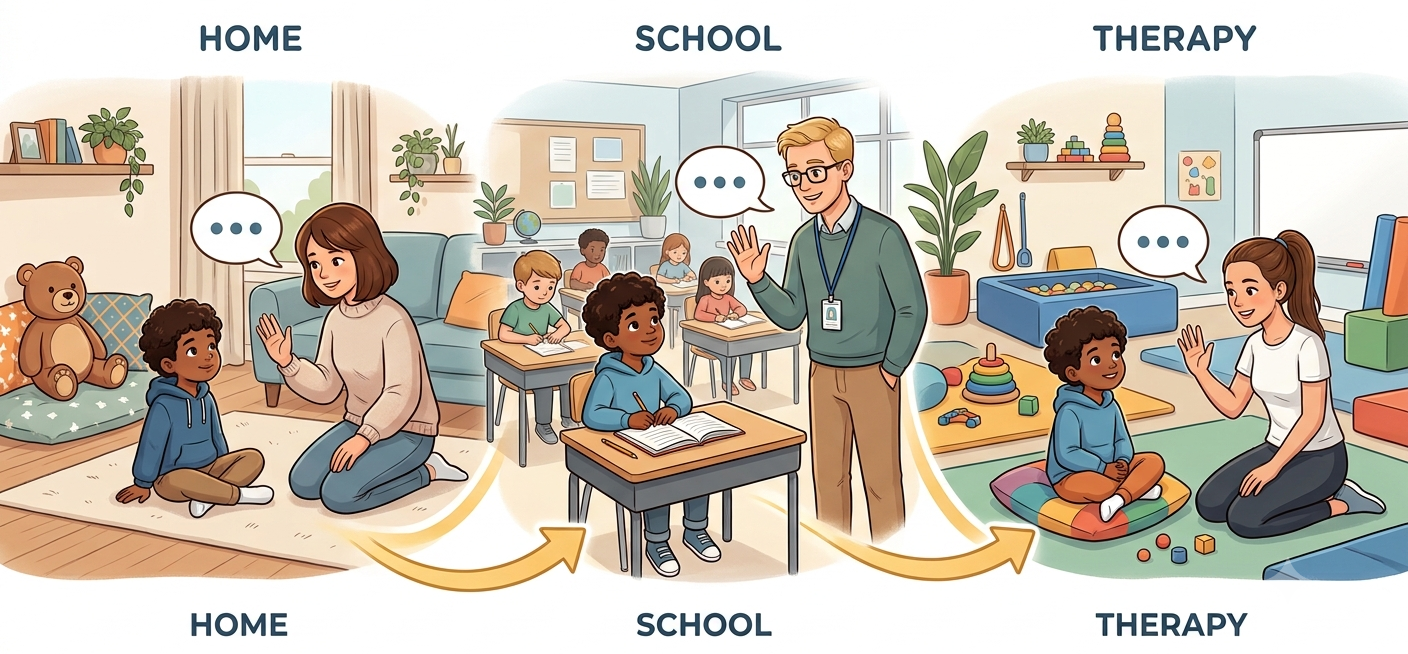
Children with ADHD often find it difficult to transfer skills from one environment to another. A calming strategy learnt during occupational therapy may not automatically be used in the classroom. A routine that works well at school may disappear at home.
Without consistency, children may feel as though every adult expects something different. When parents, teachers and therapists use similar language, routines and expectations, children don't have to relearn the same skill in every setting.
For example:
The Occupational Therapist teaches "Pause. Breathe. Choose."
The teacher uses the same words before transitions.
Parents use the identical cue before homework.
Repeated practice across different environments helps these strategies become habits.
Common Myths About ADHD
Myth: My child just needs stricter discipline.
Reality: Children with ADHD usually know what they should do. The challenge is consistently managing attention, impulses and emotions.
Myth: Therapy should "fix" ADHD.
Reality: Therapy teaches practical skills that children continue practicing at home and school.
Myth: Medication is the only solution.
Reality: Every child is different. Many children benefit from a combination of therapy, school supports, home strategies and, for some, medication recommended by their medical team.
How Different Professionals Support Children with ADHD
Children with ADHD often benefit from a multidisciplinary approach.
Professional | How They Help |
Occupational Therapist (OT) | Self-regulation, executive functioning, handwriting, sensory processing, daily living skills and classroom readiness |
Speech Therapist (ST) | Communication, listening, conversation skills, social interaction and understanding instructions |
Physiotherapist (PT) | Gross motor skills, posture, coordination, balance, movement planning and endurance |
Teachers | Apply strategies during everyday learning, observe classroom behaviour and provide consistent support |
Parents | Reinforce strategies during daily routines and help build lasting habits |
Each professional contributes a different piece of the child's development.
Real-Life Examples of Teamwork
A Child Who Avoided Writing
Instead of assuming the child was lazy, the team identified multiple contributing factors.
Professional | How They Helped |
Occupational Therapist (OT) | Addressed fine motor skills and sensory needs |
Physiotherapist (PT) | Improved posture and sitting endurance. |
Teachers | Introduced shorter writing blocks and movement breaks |
Parents | Practiced hand-strengthening activities at home |
With everyone using the same approach, writing became less stressful and the child gradually stayed engaged for longer.
A Child Who Interrupted Frequently
Professional | How They Helped |
Occupational Therapist (OT) | Introduced quiet fidget activities while waiting |
Speech Therapist (ST) | Taught conversational turn-taking |
Teachers | Used visual reminder cards |
Parents | Reinforce strategies during daily routines and help build lasting habits |
Rather than repeatedly telling the child to "stop interrupting," parents are taught to use replacement words using the same language across all environments.
A Child Who Melted Down After School
Professional | How They Help |
Occupational Therapist (OT) | Created an after-school regulation routine |
Speech Therapist (ST) | Helped the child identify emotions and request quiet time. |
Physiotherapist (PT) | Introduced heavy-work activities. |
Teachers | Communicated when routines changed or particularly challenging lessons occurred. |
Parents | Noticed emotional meltdowns happened after demanding school days. |
The result wasn't perfection, but calmer evenings and less family stress.
Practical Strategies Parents Can Start Today
Supporting a child with ADHD doesn't require long therapy programmes at home.
Small, consistent habits often make the biggest difference.
You can start by:
Giving one instruction at a time.
Using visual schedules instead of repeated reminders.
Breaking homework into shorter blocks with movement breaks.
Praising effort rather than perfection.
Preparing your child before transitions.
Keeping routines predictable.
Creating a calm space for emotional regulation.
Allowing your child to participate in choosing strategies that work for them.
Practical Strategies Teachers Can Use
Many therapy strategies can be incorporated into the classroom.
Examples include:
Visual timetables
Movement breaks
Breaking larger tasks into smaller steps
Simple, consistent verbal cues
Visual checklists
Preferential seating when appropriate
Countdowns before transitions
Positive reinforcement for effort
Allowing brief sensory or movement opportunities
Small adjustments often make a meaningful difference to participation and learning.

What Research Tells Us
Research consistently shows that children with ADHD achieve the best outcomes when support extends beyond the therapy room. Skills are more likely to generalise into everyday life when families, teachers and therapists communicate regularly, share goals and reinforce the same strategies across different settings.
Rather than relying on one person to solve every challenge, collaborative care creates a consistent learning environment that helps children practice skills in real-world situations where they matter most.
How Collaborative Centre Can Help
At Collaborative Centre, our Occupational Therapists, Speech Therapists and Physiotherapists work closely with families and schools to provide coordinated support for children with ADHD.
Our goal isn't simply to help children perform well during therapy sessions. We help them develop practical skills that can be used at home, in school and throughout everyday life.
Whether your child needs support with emotional regulation, executive functioning, communication, motor skills or daily routines, we create individualised therapy plans that focus on meaningful, long-term progress.
Progress Happens When Everyone Works Together
No single adult can meet every need of a child with ADHD.
But when therapists, teachers and parents share the same goals, use the same language and reinforce the same strategies, children receive something even more valuable than therapy alone: consistency.
For many children with ADHD, those small, repeated moments of support become the foundation for greater confidence, stronger relationships, increased independence and lasting success.